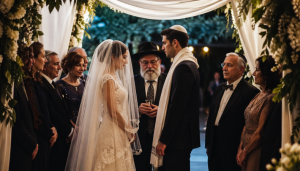

Marriage is not just a social or emotional union, but also a legal contact between couples and their families. A marriage in any part of the world affects one’s property rights, inheritance, taxation, maintenance and even personal liberty. There are two types of marriages to choose from, court marriage and traditional marriage.
Undoubtedly, both the weddings are legally valid; however, the laws that govern them, the procedures involved and the legal consequences differ significantly. Also, it is worth noting that legally registering your marriage is now a mandate in India. Doesn’t matter what kind of celebration you wish to hold; you will have to register your union. You can choose to get wedlocked in a court setting or opt for a traditional wedding and register it later. The choice is absolutely yours.
Here, in this post, we will discuss about the key legal differences between court marriages and traditional marriages. So, read this post until the end to have a clear understanding of these two wedding types. Let’s get started…
Understanding Court Marriage – What Is It?
A court marriage, as the name says is a wedding type that is solemnized under the Special Marriage Act, 1954. This kind of wedding allows couples to marry irrespective of their caste, religious background or community. These weddings are registered and are conducted by a Marriage Officer (usually a government officer or judge) in a government office. These usually involve signing legal wedding documents.
Court marriages often involve numerous legal steps and formalities to ensure the union is valid under the Special Marriage Act, 1954. Legally, these weddings are secular and derive their validity solely from statutory law. Couples who belong to different religions or castes, or those who prefer privacy and simplicity, or the ones who are opposed by families or want a legally straightforward process often choose for court marriage.
Understanding Traditional Marriage – What Is It?
A traditional marriage is the one that is solemnized according to personal or religious laws. Some of the most popular laws for traditional weddings include, the Hindu Marriage Act, 1955, Muslim Personal Law, 1937, Christian Marriage Act, 1872, Parsi Marriage and Divorce Act, 1936 and so on. Traditional marriages often include religious customs, ceremonies and rituals.
A traditional marriage is legally valid as long as it follows the rules of your personal or religious law (however, in India, registering it in the court is mandatory). These kinds of weddings are usually chosen for cultural, religious, family or personal reasons and are deeply rooted in social practices. They often include grand celebrations with high-end décor, entertainment and other kinds of frills and ruffles.
I. Court Marriage vs. Traditional Marriage: Governing Laws
Majorly these weddings differ based on the governing laws, which are as follows:
Court Marriage
- Court Marriages are governed by the Special Marriage Act, 1954.
- Court marriage is governed by a single law that applies to all Indian citizens, irrespective of their religion, background or status.
- Court marriages are not bound by religion or personal beliefs.
Traditional Marriage
- Traditional weddings are solemnized under religion-specific personal laws.
- The legal requirements in traditional weddings vary based on one’s religious background and faith.
- Traditional weddings often involve grand celebrations, where customs and rituals play a crucial role and hold legal significance.
II. Court Marriage vs. Traditional Marriage: Eligibility Criteria
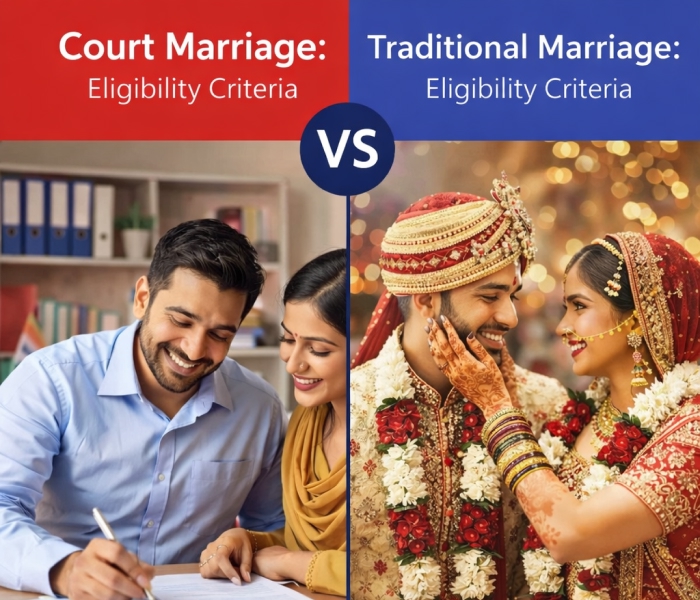
The eligibility criteria for both the marriages vary slightly. Here is the distinction between court marriage and traditional marriage based on eligibility criteria. Take a look…
Court Marriage Eligibility Under the Special Marriage Act
- Both parties must be unmarried (or legally divorced/widowed)
- Groom must be at least 21 years old
- Bride must be at least 18 years old
- Both parties must be sane and capable of giving valid consent
- Parties should not fall under prohibited degrees of relationship (unless permitted by custom)
Traditional Marriage Eligibility Depending on Personal Laws
a. Hindu Wedding Under Hindu Marriage Act
- Both parties must be unmarried, divorced or widowed at the time of marriage.
- Groom must be at least 21 years old and bride should be at least 18 years old at the time of wedding.
- Both the parties must freely consent to the marriage.
- Neither the bride nor the groom can be within certain degrees of prohibited relationship, such as close blood relations (e.g., siblings, uncle-niece, aunt-nephew).
- Both parties must be capable of giving valid consent and able to understand the responsibilities of marriage.
- Neither party should have a living spouse at the time of marriage.
Read More: 8 Post Marriage Rituals in Hindu Wedding
b. Muslim Wedding Under Muslim Personal Law
- Traditionally, marriage under Muslim Personal Law is allowed after puberty. However, now most states follow the Prohibition of Child Marriage Act, so the minimum age is 18 for women and 21 for men.
- Both parties must freely consent to the marriage.
- Muslim men are allowed to have up to four wives simultaneously.
- Muslim women cannot have multiple husbands.
- Marriages within certain close blood relations are forbidden, such as a woman marrying her father, brother, uncle, etc.
- At least two adult Muslim witnesses must be present for a marriage (Nikah) to be valid.
c. Christian Wedding Under Indian Christian Marriage Act
- Groom must be at least 21 years old and bride must be at least 18 years old.
- Both parties must be unmarried, divorced, or widowed.
- Both the bride and groom must freely consent to the marriage.
- Marriage is only valid if it does not violate these prohibited degrees of relationship.
- Marriage ceremony must be performed according to Christian rites by an ordained minister of a recognized church in presence of at least two witnesses.
- At least two witnesses are required.
- The marriage should ideally be registered with the relevant authorities for legal proof.
d. Parsi Wedding “Navjote” Under Parsi Wedding & Divorce Act
- Groom must be at least 21 years old.
- Bride must be at least 18 years old.
- Both parties must be unmarried at the time of marriage.
- Widows and widowers are also allowed to remarry under the Act.
- Both bride and groom must give free and informed consent.
- At least one party must be a Parsi or a Zoroastrian.
- Marriages between a Parsi and a non-Parsi are generally not recognized under the Act.
- Marriage is not allowed between close blood relatives, such as siblings, parent and child, uncle, aunt, niece and nephew
- The marriage must be solemnized according to Parsi customs (mostly at a Fire Temple).
- Registration of the marriage with the local authorities is required for legal recognition.
- Two adult witnesses must be present during the ceremony for it to be valid.
III. Court Marriage vs. Traditional Marriage: Notice and Objection Requirement
Court marriages vs. traditional marriage based on notice and objection requirements. Take a look…
Court Marriage
- A mandatory public notice must be submitted to the Marriage Officer 30 day prior to the wedding.
- The notice is displayed publicly.
- Anyone can raise an objection on legal grounds.
While this promotes legal transparency, it can make some couples worry about privacy and safety.
Traditional Marriage
- No public notice requirement (wedding invites or cards are sent to the guests)
- No provision for third-party objections.
- Marriage can be performed at any day or time of the year without any prior notice to any legal organization.
IV. Court Marriage vs. Traditional Marriage: Solemnization Process

Here are the details on solemnization process; take a look…
Court Marriage
- Conducted at a government office in the presence of marriage officer
- Requires two to three witnesses
- Simple declaration and signatures
- No religious rituals involved
Traditional Marriage
- Influenced solely by religious ceremonies.
- Involve rituals like pheras, nikah, vows and so on.
- Witness requirements vary by religion and faith.
Related Post: 14 Traditional Wedding Vows for Various Religion
V. Court Marriage vs. Traditional Marriage: Documents Required
The biggest difference between court and traditional marriages boils down to documentation. Court marriage emphasizes documentation, while traditional marriage emphasizes ceremonial compliance.
a. Documents Required for Court Marriages
- Birth certificate, school leaving certificate or passport for age proof
- Passport, Aadhaar card, voter ID, driving license, or utility bills for address proof.
- 3 to 4 recent passport size photos of the bride and groom.
- Government-issued ID like Aadhaar card, PAN card or passport for identity proof.
- Divorce decree or death certificate of spouse (if previously married) or affidavit declaring unmarried status (if never married).
- Three adult witnesses with valid ID proofs.
- Completed form or application submitted to the Marriage Officer.
- Affidavit of both the parties that states their marital status and that there are no legal impediments to marriage on both parties.
Optional Requirements (in some cases)
- Passport-sized photographs of witnesses
- Additional documents in case objections arises
b. Documents Required for Traditional Weddings
Generally, no documents are required for a traditional wedding.
VI. Court Marriage vs. Traditional Marriage: Registration and Proof of Marriage
Here are the details on registration and proof of marriage. Take a look…
Court Marriage
- Registration in court marriages are mandatory and automatic.
- You get your marriage certificate shortly after the wedding.
- Marriage Certificate in court marriages serves as strong legal proof of your union.
Traditional Marriage
- Registration of your wedding is now crucial for all the couples irrespective of the kind of wedding they host (You can register your wedding any time after the traditional wedding ceremony).
- Marriage certificate is obtained from the court as legal proof.
- Delay or non-registration can lead to legal complications.
- Court marriage certificates come in handy in case of any legal dispute or issue.
Court Marriage Vs. Traditional Marriage: Rights After Marriage
Here are the rights you receive in both the types of marriages. Take a look…
a. Property and Inheritance
Court Marriage
- Property and Inheritance rights come under Indian Succession Act (unless otherwise specified)
- Clear statutory rights for spouse
Traditional Marriage
- Inheritance rights come under personal laws
- Rights vary significantly by religion or faith
b. Maintenance and Alimony
Both court marriage and traditional weddings provide legal rights to maintenance, but the laws, eligibility and procedures differ significantly.
c. Divorce and Judicial Separation
- Divorce and judicial separation in court marriages are governed by the Special Marriage Act.
- Uniform grounds for divorce
- Parties need to follow civil court procedures
Whereas, in traditional marriages
- Divorces are governed by personal laws
- Grounds and procedures vary based on religion and faith
- Religious beliefs can sometime influence outcomes
VII. Court Marriage Vs. Traditional Marriage: Legal Recognition Abroad
Both the weddings are legally recognized; however, conditions may vary.
Court Marriage
- Easily recognized worldwide
- A court issued marriage certificate is accepted internationally
Traditional Marriage
- Couples may require to present additional documentation for recognition internationally
- Ritual-based proof may not be acceptable in every country.
- Registering in court becomes mandatory for immigration or visa purposes.
VIII. Court Marriage Vs. Traditional Marriage: Stability, Security, and Legal Assurance
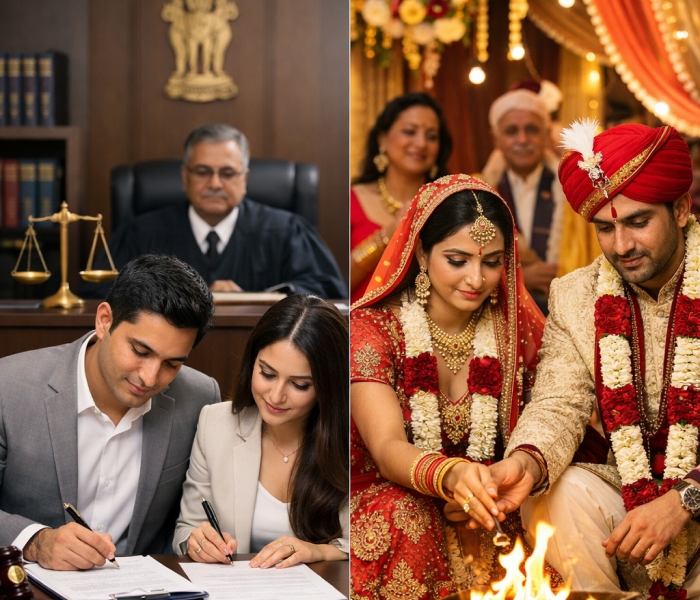
Here are the differences based on security and legal assurance. Take a look…
Court Marriage
When it comes to stability, security, and legal assurance, court marriages are more advantageous. They provide couples with much-needed legal backing and documented proof from the day they say ‘I DO.’
Traditional Marriage
In traditional weddings, mostly legal protection depends on personal laws. This can sometimes be ambiguous or lead delays when rights are tested.
The Bottom Line
So, this is all about the distinctions between court marriage vs. traditional marriage. Hopefully, this article helped you understand the legal differences between these two most popular marriage systems and choose a type of wedding that aligns perfectly with your value system and goals. Court marriages are undoubtedly legally strong and socially minimal, while traditional weddings are more socially celebrated and legally diverse.
However, when it comes to the validity of these two broad wedding systems, both are valid. From a legal standpoint, court marriage minimizes ambiguity and carry numerous legal advantages. Moreover, court weddings emphasize uniformity, documentation and civil rights, which usually lack in traditional weddings. Traditional weddings are more about religious customs and personal laws. No matter what kind of wedding you host, the idea is to have a union that is both strong and seamless. You need to pick a type that remains firm in the eyes of law.
Happy Wedding…