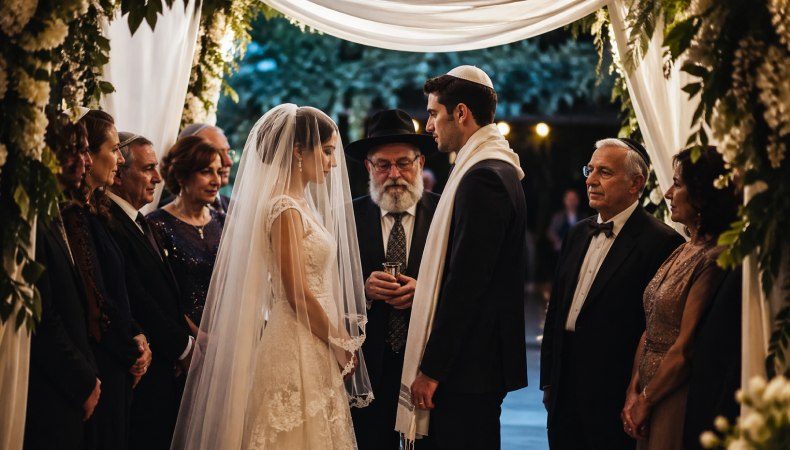
The Jewish wedding ceremony is spiritually and symbolically meaningful. The entire ceremony, from the chuppah to the final celebrations, is infused with meaning around love, commitment, faith and community. While there are differences in customs by culture/different Jewish denominations, each of the core rituals is filled with deep meaning and symbolism.
A Jewish wedding is not only about the joining of two people but also represents the establishment of a relationship between a husband/wife that is both spiritual and communal in nature. Each ritual is meaningful to both partners because they represent love, dedication, faith and joy combined with deep meaning.
1) The Chuppah (Wedding Canopy)
The chuppa is the shelter in which a Jewish couple stands during their wedding ceremony. The chuppa is the shelter that represents the couple’s future home together and is open on all sides to represent the values of hospitality and welcome located at their new home.
The chuppa also offers the couple protection from above, representing God’s protection of their union. The chuppa establishes the beginning of the couple as married.
Meaning & Significance:
- Represents the couple’s new home
- Symbolizes protection and unity
- Reflects openness and hospitality
- Connects marriage with spiritual shelter
2) The Ketubah (Marriage Contract)
The ketubah is a contract between the husband and wife indicating the man’s obligations and responsibilities to the woman; it is signed before the wedding ceremony takes place. The ketubah is witnessed and usually involves reading aloud to publicly show the couple’s commitment to each other.
Traditionally, the ketubah provided a means for safeguarding a couple’s rights and interests while married. In modern times, the ketubah serves as a memory of the couple’s commitment to each other.
Meaning & Significance:
- Defines responsibilities and commitments
- Protects rights within marriage
- Symbolizes mutual respect
- Preserved as a lifelong memory
3) Kiddushin & Nissuin (Two Stages of Marriage)
In Jewish tradition, a wedding consists of Kiddushin and Nissuin; they can both be performed simultaneously at today’s wedding. Kiddushin sanctifies the couple’s relationship, while Nissuin signifies the completion of their covenant.
Both practices represent the spiritual and legal aspects of the marriage relationship, which marks the transition to live life together.
Meaning & Significance:
- Sanctifies and formalizes the bond
- Completes the marital union
- Combines legal and spiritual elements
- Represents lifelong partnership
Read More: Love Languages in Relationships: Dating, Marriage & Beyond
4) Exchange of Rings
During the wedding ceremony, the couple exchanges rings; traditionally, the groom gives the bride the ring, but many times, couples now give each other rings at the time of the wedding ceremony.
This act symbolizes the couple’s commitment and acceptance of each other. The couple’s exchange of rings establishes the marriage relationship legally.
Meaning & Significance:
- Symbolizes eternal love
- Represents formal commitment
- Signifies trust and unity
- Reflects simplicity and purity
5) Sheva Brachot (Seven Blessings)
Sheva Brachot highlight the love and joy of the couple with a series of 7 blessings (brachot) offered during the wedding ceremony.
The community celebrates the couple through these blessings with their family or friends and connects to the divine purpose of marriage. The blessings elevate the wedding ceremony into a spiritual celebration.
Meaning & Significance:
- Blesses the couple with happiness
- Connects marriage to spirituality
- Encourages community involvement
- Celebrates shared joy
6) Breaking the Glass
At the end of the wedding ceremony, a glass is shattered with shouts of “Mazel Tov!” and this marks the end of the wedding ritual.
This moment is full of happiness, yet it also carries a deeper symbolic meaning as it serves as a reminder to each pair of their life balance between joy and reflection.
Meaning & Significance:
- Symbolizes life’s fragility
- Reflects the seriousness of commitment
- Honors historical remembrance
- Balances joy with awareness
7) Yichud (Private Seclusion)
After the wedding ceremony is over, the couple will spend time alone in their own private room, also known as Yichud. This will allow the couple to absorb the moment without the pressures of the crowd.
It is their first time being a married couple and symbolizes their sense of intimacy or emotionally connecting.
Meaning & Significance:
- Mark first private time together
- Symbolizes intimacy
- Allows reflection
- Begins married life
8) Wedding Celebrations & Community Role
Jewish weddings are joyous events that include lots of music and dancing, including some traditions such as the Hora.
The communal celebration of family and friends celebrating together demonstrates the importance of family/community when you are getting married/thinking about marriage.
Meaning & Significance:
- Emphasizes community support
- Encourages shared happiness
- Strengthens family bonds
- Reflects social connection
Conclusion
The Jewish wedding ceremony includes both religious and social customs with associated meanings. Each custom has great importance and represents a way for the bride and groom to connect to the faith and culture they both come from. The result is a ceremony that is happy and has meaning for both the couple and their families.