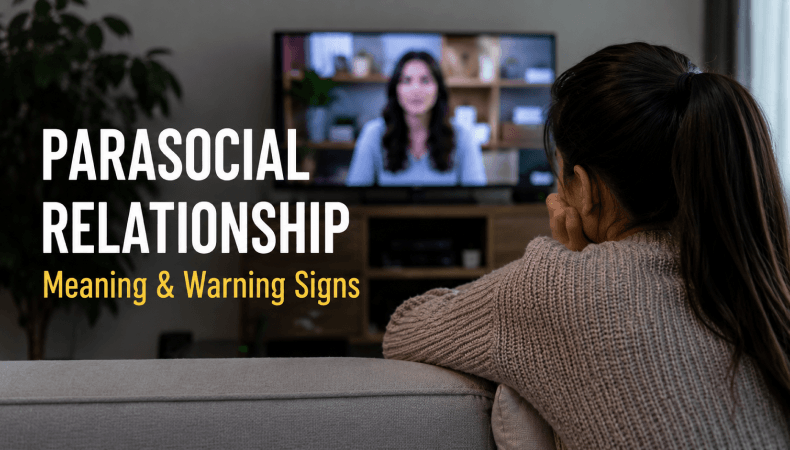
One-sided bonds with celebrities, streamers, or fictional characters feel real because your brain can’t tell the difference. Most are harmless. Some cross into obsession. Learn the three types, warning signs, and how to keep parasocial relationships healthy.
Why do humans form parasocial relationships? To grasp any kind of relationship, we have to remember that the human brain is hardwired for connection. When we like someone, whether in person or through their creative work, we immediately want to feel linked to them.
What is a parasocial relationship?
A parasocial relationship is a one-sided bond a person forms with an influencer or a celebrity. In a sense, all of these are essentially the same, because no matter how open or vulnerable a celebrity or influencer appears, they are only presenting a curated version of themselves, a choreographed narrative, if you will, which most people are oblivious about. Much like the story of a fictional character. “Parasocial” means near-social, not fully social, since these connections are almost always one-sided. Yet they often feel as if they are genuinely social. These bonds are controlled entirely by the performer and cannot develop mutually.
Most of us understand the difference between a genuine relationship (reciprocal) and simply appreciating someone’s work from a distance (non-reciprocal). People who experience loneliness or feel socially excluded often want to build relationships that are out of reach in their real lives. Nicole Liebers, a communication expert, calls this “social surrogacy.”
These relationships are one-sided by design, and they feel less like rejection and more like a circumstantial limitation; the belief that if you had ever met, you would have become friends, except that you simply never crossed paths. There’s also a sense of having more control in this kind of relationship: you created it, so you can also decide to end it.
Read More: 10 Types of Cheating in a Relationship & How to Deal With Them
The Psychology Behind Parasocial Relationships
The idea that you could truly know a celebrity by learning something about their private life has always tempted fans. Content that felt like intimate access to celebrities’ lives, a never-before-told story, a revealing exposé; these stories always sell well.
The public granted celebrities their fame, and in return, the public believed they deserved a good story or a glimpse behind the curtain. These personal angles were meant to remind us that celebrities are, after all, human. Just like us. So, parasocial relationships are neither new nor unique to the era of social media.
That said, social media has made the world feel simultaneously smaller and bigger.
Bigger, because:
- You can suddenly see just how vast the world really is.
- You can seemingly get access to millions of other people.
Smaller, because:
- You can follow or send direct messages to almost anyone.
- It has also become much easier to achieve fame or become well‑known.
The more celebrities and influencers exist, the more opportunities people have to form parasocial bonds.
Social media has also normalized the routine sharing of nearly every aspect of your life. In the past, a celebrity might only go online to promote a new album or movie—but now, those projects, along with what they ate for breakfast, are expected to be shared regularly. Especially if they want to remain relevant.
Social media has also eliminated the middleman when it comes to personal exposure. Before social platforms existed, celebrities only revealed selected parts of their lives through television and news outlets. Now, they are expected to maintain social media accounts to share more of their daily existence. Most of these accounts are usually run by managers, but that fact actually remains hidden. Further feeding the illusion of a personal connection.
Read More: Types of Relationships: Understanding the Different Ways People Connect
From Admiration to Entitlement: The Slippery Slope
Fans who felt entitled to intimacy have always existed. Before social media, the perceived distance between a celebrity and their audience was much greater. To achieve any sense of acquaintance or intimacy, physical proximity or a direct response (such as through a letter) was necessary. That distance created a clearer boundary between fan and friend, and life’s circumstances naturally protected that boundary.
Because social media has increased access to others, it has also blurred the boundaries of appropriate fan behavior. We now have direct access to verified celebrity social media accounts and their direct message inboxes. Following them can even feel more intimate than consuming their other media, like an album or a movie, or seeing them at a concert.
And so the line between a mutual relationship and a parasocial one begins to blur, as fans can leave comments on photos, reply to stories, and broadcast their opinions for the entire world to see.
The Consequences of Entitlement
When a parasocial relationship forms in a way that blurs awareness of its one‑sided nature, everyone ends up hurt.
- The fan gets hurt by the lack of reciprocity in the relationship. That usually happens because they haven’t received the response they wanted, or because their real‑life relationships suffer from neglect due to their focus on the parasocial bond.
- The celebrity gets hurt by the harassment and by the negative reputation they develop simply for trying to protect their own privacy.
Boundaries can also become blurred in real life. One of the most famous cases of fan behavior going too far was when Mark David Chapman murdered John Lennon.
Billie Eilish and Chappell Roan, both singers with huge social media followings, have reported harassment and threats that went far beyond direct messages or comments; fans began stalking them and their family members.
Navigating Parasocial Relationships in a Healthy Way
Like any kind of relationship, parasocial relationships are neither inherently good nor inherently bad. It all depends on knowing where the boundaries are and how you handle them.
There is a difference between imagination and real life. Enjoying celebrities and gossiping about them is fine. But what crosses the line into unhealthy behavior is refusing to invest in any real‑life relationship because you genuinely believe you already have, or will one day have a relationship with that celebrity or public figure.
Okay, how do you make sure you don’t cross that line?
- Focus on real, mutual relationships in your daily life.
- Remind yourself that this connection is one‑sided and therefore less real.
- Remember that there is a difference between a person’s personal life and their creative work, which they choose to show the world. Someone’s talents don’t tell us much about who they truly are. You don’t love them. You love their work.
- Would you still write that comment if you knew only other fans would ever read it and the celebrity never would? And if the answer is yes, ask yourself: is it actually helpful?
- Check in with yourself. Do you believe that person owes you a response? If you do, you have already crossed the line between admiration and entitlement.
- Any likes or comments directed back at you may not actually come from the person you are following, but from a manager or assistant.
- Do not go to their homes or other private locations unless you have been invited.
- Do not approach their family members or loved ones.
- Do not neglect your existing real‑life relationships.
- Always invest more energy in mutual relationships. Those are the ones that will truly fill and feed your soul and your need for authentic connection. One‑sided bonds can be fun, but they are not real relationships. It can be exciting to keep up with your favorite influencer’s latest posts, but that influencer is not your friend.
Conclusion
To summarize, parasocial relationships are completely natural. They arise from the human need for connection, and when kept within good boundaries, they can be pleasant experiences. However, when these bonds get out of control, and a person starts to feel entitled, they become unhealthy and harmful to everyone involved. Regularly check in with yourself to make sure you haven’t crossed the line from appreciation to feeling like you’re in a one‑sided relationship. If you are unsure, do not hesitate to ask for help.