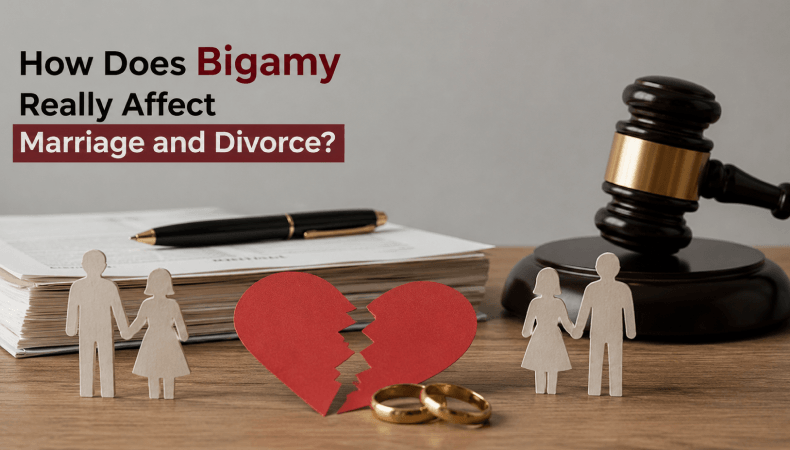
The majority of individuals believe that divorce and remarriage are the obvious steps in ending a marriage and beginning a new one. When that sequence fails, bigamy occurs. Find out what it involves.
Bigamy can be chosen for a variety of reasons, including intentionality, bureaucratic incompetence, and sometimes sincere ignorance of the requirements of the law. In each of the three situations, individuals who may not have done anything wrong face legal repercussions..
What It Actually Means
The act of getting married while still legally connected to a prior marriage is known as bigamy. The second marriage is instantly null and unlawful in almost every jurisdiction, and it is illegal in the majority of countries, including the US, UK, Australia, and India. Not voidable. Nothing. The distinction is significant: a void marriage never had legal status in the first place, but a voidable marriage can be contested and may continue if left uncontested.
Bigamy is thought to always be calculated. Often, it isn’t. In the UK, for example, only the decree absolute finalizes a divorce; a divorce decree nisi does not. When a guy in Manchester remarried after obtaining just the former, thinking the procedure was over, he discovered this. Regardless of intent, the court declared his second marriage to be void. Many people have unknowingly found themselves in a similar situation due to confusion over foreign divorce procedures, misplaced documents, or a previous marriage entered into abroad under different naming traditions.
The Marriage That Never Was
The second marriage is unraveled rather than just ending when bigamy occurs. The legal instruments available to both parties are altered when courts regard it as if it never happened.
Strictly speaking, a lawful marriage is necessary for a divorce to be dissolved. A bigamous second marriage must be canceled rather than divorced. A nullity petition must be submitted in the UK within three years after the marriage date. Similar reasoning is used in the majority of US states and Australian jurisdictions. The partners are legally returned to their pre-marriage position after the annulment, which renders the marriage void.
This distinction creates an immediate financial problem. Divorce law generally entitles both spouses to some share of marital assets. Annulment law in most countries does not. California is explicit on this point: community property rules do not apply to a void marriage, meaning each party keeps what they brought in, and jointly acquired assets require separate civil action to divide. Spousal support is also unavailable — unless a spouse can establish they are a “putative spouse,” someone who genuinely and reasonably believed the marriage was legal. In those cases, courts may grant limited financial relief, but it requires proof of good faith.
What the First Marriage Does
The first marriage, meanwhile, remains entirely intact unless actively dissolved. Discovering that a husband or wife has married someone else does not void the original marriage. It does, however, allow the first spouse to pursue divorce based on the other party’s conduct. In jurisdictions where fault still affects financial settlements, bigamy can meaningfully factor into those proceedings.
The 2018 Wirral case is instructive. After nine years of marriage, a nurse learned that her husband had been lawfully wed to another lady at the time of their union. In order to declare the marriage void from the beginning, she requested and was granted a declaration of nullity.
She continued to seek financial claims in court despite the nullity verdict, and she was successful. Nine years of shared financial life were not eliminated by the annulment, and judges had the authority to confront such realities even in the absence of a legally recognized marriage.
Children Stay Protected
Parenthood is one circumstance where the legal shadow of bigamy does not apply. Children born into bigamous marriages have full legal rights to both parents, inheritance, and support in every country that views such marriages as null and invalid. Children are not punished by courts for events in which they have no involvement. The legitimacy of the marriage has no bearing on parental rights, and custody and child support procedures follow just as they would in any divorce.
Since this is frequently misinterpreted, it is important to state it clearly. The legal illusion that a bigamous marriage “never happened” solely pertains to the marriage. The resulting parent-child bond is seen as wholly genuine.
Criminal Exposure
In addition to family law, bigamy carries criminal penalties that differ greatly between jurisdictions. It carries a maximum punishment of seven years in England and Wales. Penalties in the US vary from petty fines in certain states to felonies in others. A conviction in California carries a maximum sentence of one year in prison, penalties of up to $10,000, and additional fraud charges if the concealment was deliberate.
In reality, prosecutions are rather uncommon. When there is obvious deceit and financial exploitation, such as when a second spouse is cheated of assets or savings or when immigration fraud is enabled by a fictitious marriage, courts are more likely to file criminal charges. Even while there are still civil repercussions, prosecutors frequently have less desire to pursue criminal charges where bigamy was the product of an honest misunderstanding or administrative error.
International Complications
Domestic law does a bad job of handling the additional layer that cross-border marriages provide. A marriage that is deemed lawful in one country may not be recognized as such in another due to the significant differences in marriage laws between nations. It’s possible that a person who was married under customary law in one nation and subsequently entered into a civil marriage in another without formally dissolving the first may not have been aware that the first union had legal significance outside.
These kinds of cases have been presented to courts in the UK and Australia, and the results mostly depend on whether the laws of the nation where the second marriage was consummated would recognize the first marriage.
This is one area where checking marital status before remarrying matters considerably more than most people assume. Public marriage records, requests for certified divorce decrees from foreign courts, or verification through a family law solicitor can confirm what paperwork alone often cannot.
The Simpler Version
Bigamy doesn’t require malice to cause legal damage. A marriage entered in good faith by one party, based on incomplete paperwork or a misread process, can still void that marriage entirely, strip both spouses of financial protections they expected to have, and send them through an annulment process rather than the divorce proceedings they anticipated. The law treats marriage as a precise legal contract.
Bigamy — whatever its cause — breaks that contract before it begins.