
Marriage is a sacred and legally significant institution around the world. Of course, there are different ways you can tie the knot. Among several ways, court marriages are becoming very popular. However, it is crucial to note that the legal process of getting married differs from country to country. Every nation follows its own laws, age requirements, documentation rules and procedures to legally validate couple’s union. Couples who prefer a simple, non religious and legally recognized union often choose court marriages.
Court marriage allows couples to formalize their relationship under civil law without performing traditional or religious ceremonies. Some countries especially India has made it mandatory for couples to legally register their marriage under Hindu Marriage Act, 1955. So, even if you get married religiously, you will have to register your wedding in India. Well, some couples prefer to get hitched only the legal way.
So, if you are the one, read this post. Here, we have outlined some of the most important things about court marriages across the world to help you be aware of all the laws and formalities before you finally say “I DO” to your partner. So, without any further ado, let as get started…
What Is A Court Wedding?
A court wedding is a civil marriage ceremony. These marriages are conducted in the family courts by a judge, magistrate or another legally approved government official. More often than not, these weddings take place in courthouses or authorized venues. Court marriages as the name says, do not include religious rituals or customs. In fact, they are governed by strict legal procedures to officially validate a wedding. Court marriages are generally short, often last 20 to 30 minutes. But the point to consider here is – these weddings cannot be personalized as much as the traditional weddings.
Yes, you cannot arrange for décor, food or other arrangements at courts. Unlike religious weddings, where a lot of customs are followed to sanction the union, court marriages are excessively simple and short.
These weddings require signing official documents in the presence of the judge or magistrate. You may be allowed to exchange your vows (if you ask for permission). Couples who care more about legal recognition than a grand celebration often opt for court marriages. They allow them to have a legal proof of their marriage without spending overwhelmingly on wedding ceremonies.
Almost all the countries in the world including the UK, USA, Australia, Canada, Singapore, Japan, China, India and others have provision for court marriages, apart from traditional weddings. No matter where in the world you sign marriage documents in the court, these weddings hold same legal values as traditional weddings.
Why Are Court Marriages Gaining Popularity?
Court marriages are gaining popularity for several reasons, such as:
- Easy to Conduct: The biggest advantage that comes with court marriages is that they are very easy to conduct. Not much effort or preparations are required for a court marriage. These celebrations are easy and simple to conduct. Compared to traditional weddings, they involve very little planning, fewer expenses and almost no stress.
- Suitable For All: Court marriages are suitable for all kinds of couples irrespective of their caste, creed, nationalities, religious background and cultural backgrounds. Couples who appreciate the simplicity or cannot afford long planning timelines or complicated arrangements also prefer such weddings.
- Budget friendly Option: Court marriages are the most budget friendliest wedding options – ideal for all who wish to get hitched without breaking the bank. A court wedding removes the need for expensive venues, catering, decorations, entertainment and long guest lists, making the entire process stress free and budget friendly.
- More Intimate & Private Ceremonies: Another most important reason for the gaining popularity of court marriages is their intimate and private nature. These weddings are very intimate ceremonies where the couple’s main focus is on their commitment and not on impressing guests with lavish arrangements.
- Environmentally Friendly Options: This era is the era of advancements and at the same time more and more people are moving to environment friendly living options. A court marriage is one of the best ways of opting for an environment friendly marriage and reduce waste and unnecessary consumption.
- Time Saving Procedure: Court marriages do not take long times for completion, like traditional weddings. These weddings usually take 20-30 minutes to complete and require only signing a few documents.
However, you can say your weddings vows in the presence of the judge (if you wish so). Even then it doesn’t take much time to complete. Also, you don’t require to plan a lot of things for a court marriage in any part of the world. - Practical & Budget-Friendly: Court marriages are especially popular among couples who are short on time, working with a limited budget or who simply want to avoid the pressure of a big celebration. Before booking a court wedding, it is important to check details such as the officiant’s authorization, required documents, available dates, witness rules and optional services like photography or certified copies. This guide explains everything you need to know in a clear and practical way.
- Legal Convenience: As said earlier that registering marriage in court is now a mandatory step even if you get wed locked in a religious or traditional wedding. Besides that, couples dealing with immigration or legal documentation especially who need fast and official proof of marriage opt for this system. In some countries, marriage licenses and ceremonies are completed on the same day, making court weddings an extremely practical choice for couples.
So, these are the reasons court marriages have become so popular. These weddings are perfect for couples who want a simple, private and efficient process for making their relationship official. Undoubtedly, a court marriage is a great option to make your relationship official they are the fastest, most affordable and legally secure ways to officiate your union.
However, if you wish to opt for a court wedding, the first thing you should check whether or not it is legally valid in your area. Read the next section for the different types of court weddings. Here we go…
Different Types of Court Weddings
Court marriages vary based on the country, location and local laws. Here are some of the most popular options; take a look…
1. Traditional Courthouse Ceremony
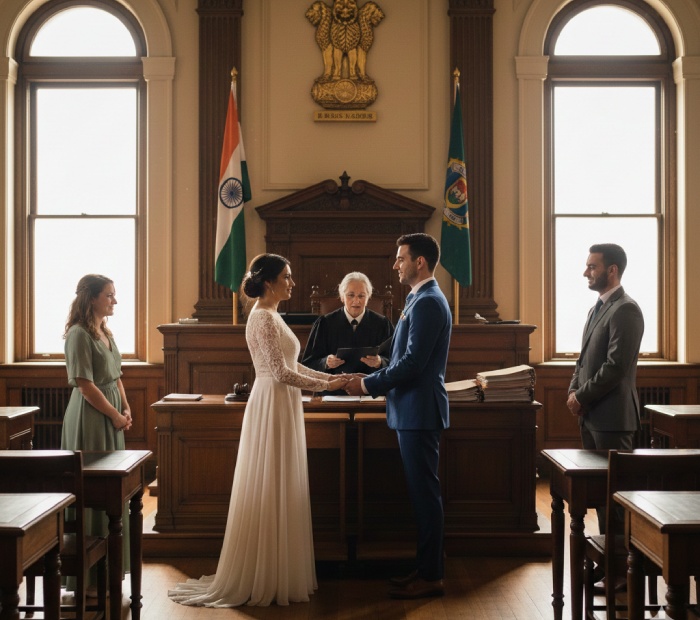
This is the most common type of court wedding. In this, the ceremony takes place inside a courtroom during regular working hours of the family courts. In this kind of court wedding, couples are required to complete paperwork in advance, bring witnesses (if required) and participate in a short, formal ceremony.
Pros:
- Very low cost
- Fully legal and reliable
- Easy to access
Cons:
- Fixed schedules
- No option for personalization
- Formal and impersonal setting
2. Private Civil Ceremony
Private civil ceremony is yet another kind of court marriage. These marriages are conducted by a Judge in offices, gardens or approved locations, depending on local rules.
Pros:
- More relaxed ceremonies
- Option for personalization
- Flexible timing
Cons:
- Limited availability
- May require advance booking
3. Mobile or Pop-Up Court Weddings
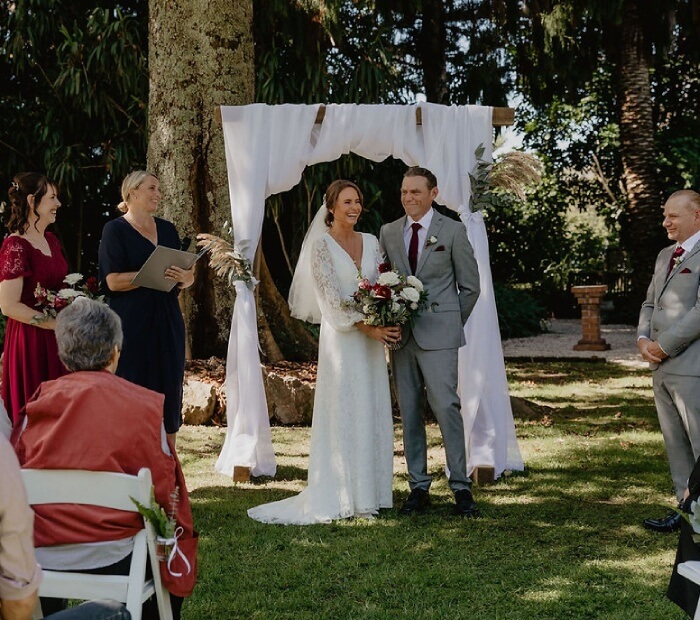
Mobile or Pop Up court weddings as the name says are the temporary marriage stations that are set up during busy seasons like Valentine’s Day or New Year. They are a mix of a small court wedding and a big traditional one.
Pros:
- Quick and convenient
- More intimate & customizable
- Festive atmosphere
Cons:
- Limited slots
- Not every country has option for such weddings
4. Court Wedding & Celebration Later

Lastly, court wedding & celebration later is yet another popular option among couples these days. More often than not, couples prefer to legally marry at court first and host a traditional celebration later. This allows couples to officially legalize their relationship first while enjoying complete freedom to plan and customize their wedding later.
Pros:
- Legal security early
- Options to customize your wedding
- Freedom to plan a bigger event later
Cons:
- Two separate events to manage
- Require lot of time, effort and money
No matter the kind, all court weddings follow legal rules. Yes, all of these types may vary in their processes but the final outcome is same – to legally officiating a relationship.
Once again, it is worth noting that court marriages are conducted differently across countries. The procedures differ based on location and local laws. Read ahead for to learn about the process of court weddings in different parts of the world. Here we go…
Court Marriages in Different Parts of the World
Here are the processes that are followed in different countries when it comes to court weddings. Take a look…
Australia
Court marriages in Australia are governed by the Marriage Act, 1961. Couples need to fulfil some requirements in order to legalize their wedding under the Marriage Act, 1961 in Australia, these requirements include:
- Both parties must be at least 18 years old
- Both must be mentally competent
- Couples should submit a Notice of Intended Marriage at least one month before the wedding date
Once these legal requirements are fulfilled, you become eligible for a court wedding or a private civil ceremony by a registered celebrant.
United States of America
In the United States, court marriage laws are governed at the state level. This means that court wedding laws in the USA varies significantly based on state. However, some legal requirements always remain same, such as:
- Minimum age (varies by state)
- A marriage license must be obtained before the ceremony
- Waiting periods (vary by state)
Once the license is issued, the marriage can be solemnized in a courthouse or any location permitted by state law, often by a judge or authorized officiant.
United Kingdom
In the United Kingdom, court marriage is regulated by the Marriage Act, 1949. There are certain conditions for court marriages in the UK. These conditions include:
- Both parties must be at least 16 years old
- Both must be legally capable of marriage
- Require two witnesses
- Couples must give at least 29 days’ notice at a local Register Office
They must live in the district for 7 days and the ceremony must be held within 12 months at a register office, courthouse or any other approved venue with a registrar and two witnesses.
Canada
In Canada, court marriage rules are determined by provincial laws. Therefore, you may get to see different laws in different provinces. However, some laws remain common in all the provinces which include:
- Minimum marriage age (varies from one province to another)
- Must be registered in advance
- A valid marriage license (mandatory)
- Consent of both parties (mandatory)
If these conditions are met, couples become eligible for a court marriage. These weddings can either happen in a courthouse or any approved venue.
India
In India, court marriage is governed by the Special Marriage Act, 1954. Under this act, individuals from different religions or backgrounds can officiate their weddings in the court. Court weddings in India can happen either in the court room or in any approved venue by an authorized marriage officer. Conditions to become eligible for court weddings in India:
- The groom must be at least 21 years old and the bride must be at least 18 years old
- Both parties must be of sound mind
- Neither party should have a living spouse at the time of marriage
- Three witnesses who are adults
- The couple must submit a notice of intended marriage to the Marriage Registrar at least 30 days before the wedding date
After this notice period and verification, the marriage can be solemnized in a court or another approved location.
Singapore
In Singapore, court marriages are governed by the Women’s Charter and are conducted at the Registry of Marriages (ROM) and are fully recognized under Singaporean law. Common legal requirements include:
- Both parties must be at least 21 years old (or 18 with parental consent).
- Both must be legally free to marry (not currently married).
- Consent must be given freely and voluntarily.
- Two witnesses who should be adult
Couples must submit a Notice of Marriage to the ROM at least 21 days before the intended date and this notice remains valid for 3 months. The marriage must be solemnized at the ROM or a licensed venue approved by the Registrar of Marriages, such as hotel or private venues approved for civil ceremonies.
China
In China, court marriages are legally recognized under the Marriage Law of the People’s Republic of China. Court weddings in China are entirely civil and non religious. They majorly focus on the legal registration of the union. Some common requirements include:
- The groom must be at least 22 years old and the bride at least 20 years old
- Both parties must give free and voluntary consent
- Couples should present proof of local household registration (hukou) or temporary residence permits if they live in a different city.
- Both parties must be unmarried or previous divorces must be documented with a legal divorce certificate.
Pakistan
In Pakistan, court marriage is governed by the Muslim Family Laws Ordinance, 1961. Court wedding system in Pakistan only applies to Muslim couples. Requirements include:
- The groom must be 18 years or older and the bride must be at least 16 years old
- Both individuals must be mentally competent
- Free consent of both parties is mandatory
- A notice period of one month is required before the marriage is formally registered
If the requirements are met, the marriage may take place in a court or another mutually agreed location and must be officially documented to be legally recognized.
Japan
In Japan, court weddings are conducted at the local city or ward office. Some legal requirements include:
- Both partners must be at least 18 years old
- Both should be legally entitled for wedding (not already married)
- Both parties must be legally free to enter marriage under their own national laws
Couples must submit required documents including ID and a marriage notification form and the marriage becomes legally valid once registered without any need for religious ceremony.
Bangladesh
Court marriage in Bangladesh is governed by the Special Marriage Act, 1872. These weddings are mainly used for interfaith or civil marriages in Bangladesh. Eligibility criteria include:
- Groom must be 21 years old and bride must be 18 years old
- Both parties must be of sound mind
- Neither party should already be married
- Couples should give a one month notice prior to the marriage.
Once the notice period is completed and no legal objections arise, the marriage can be solemnized in a court or another approved/authorized place.
Nepal
In Nepal, court marriage is governed by the Marriage Registration Act, 2028 (1971). The legal requirements include:
- Groom must be at least 20 years old and the bride must be 18 years old
- Both individuals must be mentally fit to marry
- Consent of both parties is mandatory
The couple must give a one month notice prior to the wedding. After document verification, the marriage can be registered in court or at another approved venue, making it legally official.
Spain
In Spain, court marriage is handled through the Civil Registry. The process includes:
- Submission of documents such as birth certificates, passports and proof of residency
- Foreign nationals must provide a certificate of legal capacity to marry from their home country’s consulate
After document verification, the couple must attend an appointment at the Civil Registry to sign the marriage certificate. The marriage is then officially recorded in the Central Civil Registry, making it legally valid.
Thailand
In Thailand, court marriage is conducted at the local district office (Amphur). Some legal requirements include:
- Passports and identification documents
- A declaration of freedom to marry
Foreign nationals must submit a letter of affirmation from their embassy in Thailand, confirming they are legally free to marry. After document verification, the couple can sign the marriage certificate which is then registered in the National Registration Database, granting full legal recognition.
Most Common Documents Required for Court Marriage Worldwide
Here are the documents that are MUST no matter where in the world you get hitched. Take a look…
- Proof of Identity (such as Passport, National ID card, NRIC, Aadhaar, Driver’s license)
- Proof of Age (such as Birth Certificate, Passport, School Certificate with Birth Details)
- Proof of Marital Status (such as Affidavit or certificate of no impediment, Divorce decree or dissolution certificate, Death certificate of previous spouse)
- Address Proof (such as Utility bills, Lease agreements, Government issued residence certificates, etc.)
- Notice of Marriage / Application Form. Most countries require couples to submit a formal notice or application to the relevant registry including India (Notice under the Special Marriage Act), Singapore (Notice of Marriage to the Registry of Marriages (ROM)), United States (Marriage license from the county clerk).
- Parental Consent (If Under Legal Age)
Special Documents for Foreign Nationals
Couples involving at least one foreign citizen need to have the following documents…
- Certificate of No Impediment from their home country
- Visa or residence permit
- Translations of foreign documents by a certified translator
- Legalization or apostille for documents in some countries. Such as in Thailand, foreigners must provide a letter from their embassy confirming they are free to marry. In Spain, they need a certificate of legal capacity to marry.
Witnesses
Witnesses are yet another important part of court marriages worldwide. The requirement for witnesses vary significantly based on location and legal law. Take a look…
- Names and IDs of two or three witnesses (minimum age usually 18)
- Witnesses may need to sign the marriage certificate
Additional Documents
Some registries may require:
- Pre-marital counselling certificate (some U.S. states)
- Medical certificates (rare, mostly historical or in specific countries)
- Photographs for registry records
Court Marriage Cost
Court weddings are generally affordable. The cost of court marriage includes only the basic service fee. Here are the details:
- $25–$75 for basic services
- $75–$150 with appointments and copies
- $150–$300+ for private rooms or added services
Important Things to Consider Before Choosing a Court Wedding
Before you finalize your court wedding, here are some things to consider to make your court wedding a successful event. Take a look…
- Officiant Authorization: Make sure the judge, magistrate or clerk is legally allowed to perform legal marriages.
- Marriage License Rules: Most places require a marriage license, sometimes with a waiting period. Make sure to have complete knowledge of those rules and laws.
- Required Documents: Make sure to arrange for all the required documents in advance. Some common documents include government ID, proof of age, divorce papers (if applicable) and residency proof.
- Witness Requirement: Some countries, such as India need adult witnesses (2 to 3), make sure to arrange for the adult witnesses to sign the documents.
- Scheduling Options: Check if appointments are needed and whether weekends are available.
- Privacy: Ask if the ceremony is public or private.
- Extra Services: Some courts offer photography, live streaming or extra certificate copies for a fee. Gather information and accordingly choose for the services.
Undoubtedly, court marriages are simple and effortless procedures, still they require some planning to ensure no chaos later. Read ahead for the step by step guide to ensure a successful wedding in court. Here we go…
Pros and Cons of a Court Wedding Around the World
Pros:
- Very affordable
- Time saving procedures
- Fully legal and official
- Require minimal planning and stress
- Instant processes
Cons:
- Limited customization
- Simple and formal setting
- Fixed schedules
- Limited options for guests
Step by Step Guide For a Successful Court Wedding
Here are some of the most important steps that you need to follow to ensure your wedding in court is successful and effectively managed. Take a look…
- Check Local Laws: Marriage rules depend on the location where you marry. Hence, make sure to check all the local laws beforehand.
- Confirm Eligibility: Verify age rules and divorce requirements in advance to ensure to complexity later.
- Contact the Courthouse: Contact the courthouse or civil court to ask about licenses, documents, witnesses and ceremony slots in advance.
- Book Early: Popular dates fill quickly: therefore, you are advised to book your wedding dates in advance.
- Verify Officiant Credentials: Ensure the judge or magistrate who will conduct the process is eligible for the wedding.
- Gather Information on Fees: Ask about license fees, copies and extra service costs and make sure to deposit them all in advance.
- Plan the Day: Choose a simple attire for the ceremony, arrive at least 30 to 45 minutes prior to your time with all your documents.
- Use Official Government Sites: Only use official government websites to register your wedding online so that things are smooth and seamless. Also, it will help you avoid scams. Aside from that, it is crucial to confirm details directly with the courthouse instead of relying on third party or others.
Pro Tip: Make sure to keep your marriage certificate safe, order multiple certified copies and update legal documents and records.
The Bottom Line
So, this is all about the legal weddings around the world. Hopefully, this article has been informative for you and helped you understand the nitty gritty and processes required for a wedding in court. Court weddings are fully legal procedures and the best part about these weddings is that they are smart, simple and most affordable legally secure weddings. They may miss the glamour of a traditional wedding but the peace of mind, affordability and efficiency these weddings offer is unbeatable. With proper preparation and clear understanding of the process, a court wedding can be a meaningful first step to begin the new journey of your life. Also, don’t miss to follow the tips outlined above. Following these tips will help you manage and enjoy the significant milestone of your life thoroughly.
Happy Wedding…