
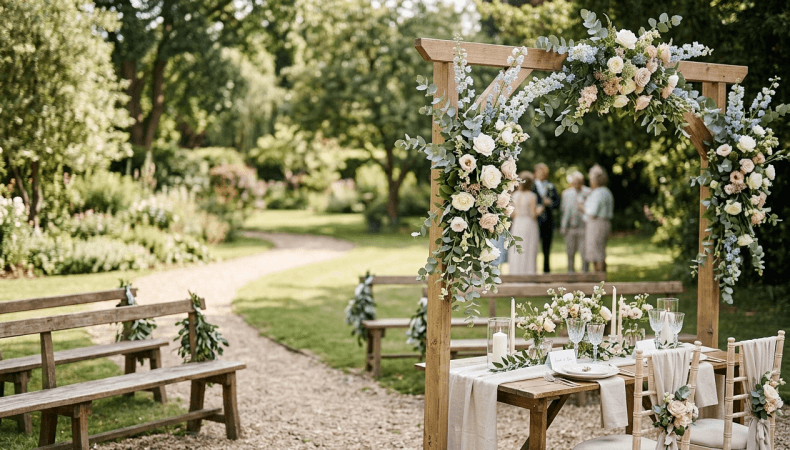
Big guest lists, heftier budgets, and months of mania, does that describe your dream wedding or someone else’s? If avoiding that image in favor of an intimate gathering feels less like a blow-by-blow and more like a sigh of relief, you’re not alone, and this article will show how to do so.
Is a Small Wedding Right for You?
Before you sign your first vendor, it helps to know what “small” looks like to you. A small wedding isn’t just a smaller version of a big wedding , it’s a whole other kind of good vibes planning, with its own jump tempo, priorities, and opportunities. Some couples want fewer guests, but everything else you love; some want to downsize to the essentials. Knowing where you sit on the scale can help with many of the decisions to follow.
Small Wedding vs. Micro Wedding vs. Elopement
| Type | Guest Count | Typical Duration | Best For |
| Small Wedding | 30–75 guests | Full day, traditional format | Couples who want close family and friends without a massive production |
| Micro Wedding | 10–30 guests | Few hours, simplified format | Couples prioritizing intimacy but still wanting a “wedding day” feel |
| Elopement | 2 guests (or none) | A few hours or less | Couples who want the marriage, not the event |
Benefits of Having a Small Wedding
- More budget per guest, better food, décor, and venue, for less total cost
- Easier to personalize each and every detail, instead of juggling logistics for hundreds
- Less stress, and fewer things to coordinate
- More meaningful interaction with each guest, instead of a queue of rushing greeters
- Greater flexibility with nontraditional venues and scheduling
- Less planning time to fit into busy schedules
Small Wedding Planning Checklist: What to Plan First
First, you have to decide that your wedding is small. Then you can start planning. The advantage of a smaller wedding is that there are fewer things to worry about, but the order in which these things get taken care of does matter. Here are the first things you should consider so that you can get the rest sorted out more quickly.
Read More: Wedding Planning Checklist – A Guide To Plan Your Dream Wedding
Set Your Budget and Guest Count
- Set an overall budget that guides all planning
- Set a firm limit on your list of guests (this is the biggest cost factor)
- Allocate your budget per priority: venue, food, photography, attire, and so on
- Allocate 10% of the budget for unforeseen expenses
- Record all the purchases in an excel spreadsheet or a planning app right from the start
Choose Your Date and Venue
- Season/weather: Is the venue suitable for being outdoors, or is there a viable indoor backup?
- Venue type: Restaurant, backyard, vineyard, etc. that is suitable for weddings?
- Space/Crowd fit: Is there enough “body” in the space for your crowd, or is it too cavernous?
- Date availability: Will they have a weekday or off-season date that could be an option? (often cheaper)
- Included items: Is the venue already equipped with tables, chairs, catering, or will I have to bring in outside vendors?
Reserve Your Essential Vendors
- Photographer/videographer
- Caterer/restaurant venue with in-house catering
- Officiant
- Florist/fitting of trade
- Hair and makeup artist/personal hair stylist
- Musician/DJ/playlist
- Baker for wedding cake/dessert table
Plan Your Outfits and Wedding Rings
- Decide your wedding attire now, plan for any necessary tailoring
- Plan out your rings (size, engraving) a few weeks in advance for optimization.
- Plan out your outfits for dress code changes, accessorizing (shoes, jewelry, etc.) and get outfit ideas for your reception
- Plan out outfits for immediate family so that they know what to bring to the wedding
Plan Food, Drinks, and Cake
- Choose menu: Family style, plated dinner, or curated small-batch tasting
- Choose bar style: Full bar, signature cocktails, etc., or perhaps wine and beer only
- Place a smaller cake or dessert table for this intimate event.
- Survey your guests for any dietary restrictions and plan accordingly.
Plan your Ceremony and Reception
- Determine ceremony structure (readings, vows, rituals)
- Select music for processional, ceremony, and recessional
- Plan space layout for an intimate venue
- Decide on toasts and speeches and who will make them
- Schedule photos, dinner, and dancing
Send Invitations and Manage RSVPs
- Compile guests, addresses
- Pick invitation style , physical, digital or both
- Mail invites 8–10 weeks before your wedding
- Decide on an RSVP deadline and track responses
- Follow up yourself on any late responders (this is easier with smaller list)
Arrange Guest Travel and Accommodation
- Provide nearby hotel listings or a block if guests are traveling
- Provide local transportation or arrange local transportation and/or shuttle that day
- Mail a basic itinerary if your wedding is a weekend affair
- Confirm any special accessibility options on venue and arrangements transportation and accommodation relevant to that need.
Complete Legal and Marriage Prerequisites
- Apply for your marriage license in your state or country’s valid window
- Check the legal status of your officiant
- Arrange for witnesses if need be
- Arrange for a name change if that’s what you’re doing
Small Wedding Ideas for a More Intimate Celebration
- Handwrite your vows onto the page (instead of a prewritten spec)
- Choose a venue with a significant history (zookhanas are gaining traction)
- Handwrite seating chart or menu for each guest
- Serve a family recipe with your meal, if you wish
- Share the cake and serve a dessert that tells your story
- Ask for notes rather than cards for your keepsake box
- Play a setlist of songs created from your most meaningful moments
How To Manage Your Guest-List and Family Dynamics
Hosting a small ceremony means that one of the most emotionally difficult things for couples is diminishing the guest list. And you could be missing this because it happens so seamlessly, so naturally, so cuspless… You’ve decided some loved ones aren’t going to be in the room. You’re already desperately thinking about a plan to get over it. Do not react. Think first.
Surprise is where the most unnecessary tension in invite lists comes from. Have an early conversation with both families about your vision and why you want a small celebration.
Then make a rule. “It’s just for a close circle of family and friends.” Then be consistent. Do not have a right to go with a family that’s a little more generous. And what about the people you did cut? If you are cutting a lot of people, expect to be met with the anger of those people.
Consider a small celebration for your “inner circle,” with an “open house” party afterward for the folks you didn’t manage to get onto the invite list. Most importantly, be transparent. A smaller list doesn’t mean you’re offending people; just a gentle heads up can help you out.
Small Wedding Timeline: Key Planning Stages
| Timeframe | Key Tasks |
| 6–9 months before | Set budget, guest list, book venue and major vendors |
| 4–6 months before | Choose attire, finalize menu, book photographer/officiant |
| 2–3 months before | Send invitations, plan ceremony details, order rings |
| 4–6 weeks before | Confirm RSVPs, finalize seating and timeline |
| 1–2 weeks before | Confirm vendor details, pack essentials, final fittings |
Final Week Small Wedding Checklist
- Figure out final numbers with bartender and venue
- Purchase or locate dress and accessories
- Move payment and tips into the bag for each vendor
- Pack an emergency kit (don’t know what’s coming, sewing kit, stain remover, snacks)
- Loop in arrival times for everyone
- Bring a friend or wedding day coordinator to assist with delegation
- Relax and have fun with the last leg of this; the hard part’s over
Typical Small Wedding Planning Mistakes to Avoid
- Choosing a list too large for a short list creates negative feelings of “superfluous.”
- Also not noticing that the cost per head increases when you have a small list of guests.
- Also having a “friendly” wedding and hoping the vendor won’t come asking for a written contract.
- Also not understanding that you’ll have to handle certain legal papers, although it’s more focused on design and style than business.
- Telling your guests your small wedding means the tip of the iceberg is their number and only your closest family and friends will be invited.
- Segmenting your wedding day into little episodes that diluted the intimacy.
Wrap up
You don’t have to compromise on a small wedding, you just have to focus on the baby steps. With a specified budget, realistic timeline, and a concrete to-do-list that determines your priorities you can go for a rich, sentimental, personal wedding that feels rich, even with a smaller guest-list. Begin with the basics, embrace how you and your partner relate to each other, and allow the smallness to work for you.
FAQs
What is considered a small wedding?
Depends on the venue, but it’s the 30-75 guest range, more or less.
Is a small wedding cheaper than a big wedding?
Yes. Because the number of guests is smaller, you save money on catering and staying, but you spend more per-guest because you pour more money into guests.
How far in advance do I have to plan a small wedding?
It depends, of course, but the mean is six to nine months. Still, small wedding guests are light and can be booked down to three months from now.
Can I have a small marriage with a party?
Yes, many couples extend ”best friends” and ask one or two attendants, rather than a wedding party.
Do I have to hire a wedding planner for a small wedding?
Perhaps not, but a day-of coordinator will handle the logistics so you and your family may enjoy the day.