
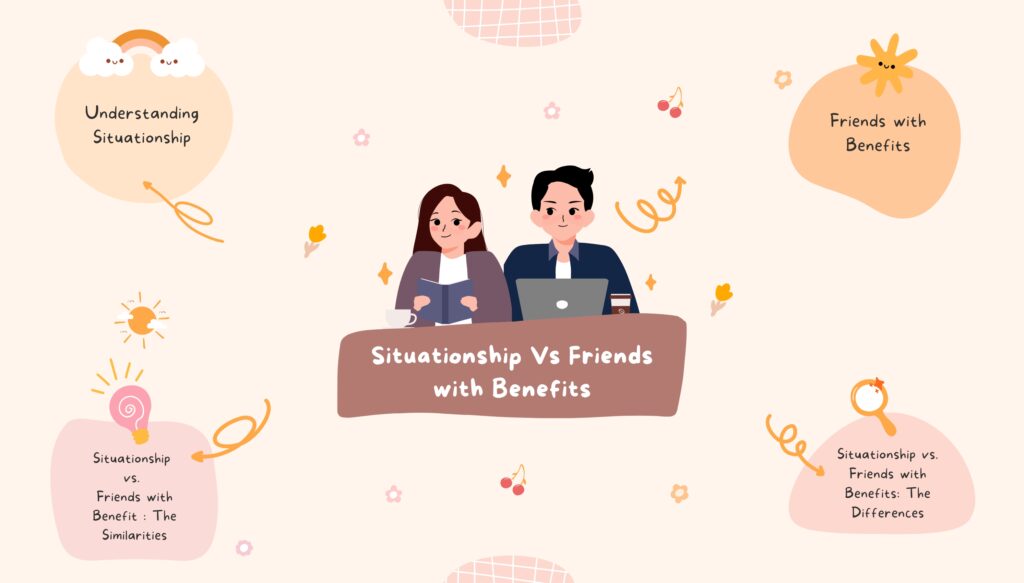
Your relationship status probably never fell into a neat little box anymore. Two of the most confusing labels for people worldwide are situationships and friends with benefits. Both feel lovely and potentially dangerous. Yet understanding the difference between them can help you choose a healthier, clearer path for your relationships and emotional health.
What Is a Situationship?
Have you ever felt tied so closely to another person, that you’ve never been able to be strangers again, yet no one had any idea what that really was?
That is a situationship. Psychology Today has defined situationships as a romantic relationship that is something between casual dating and a committed relationship. Neither party has officially defined the relationship. Both parties act like couples, yet never really say it.
Emotions aren’t the thing that’s missing. In a situationship, you send each other texts, you go out on weekends, you introduce each other to your friends, you act like a couple, yet no one ever says what the heck’s going on. It’s easier to not be vulnerable; at first, the ambiguities feel special, but over time, emotional exhaustion sets in.
As relationships therapists say, situationships arise in particular when one or both people fear vulnerability. In comparison to rejection, the unknown feels safer than the label. Thus, when you get into emotional intimacy, the commitment stays off the shelf.
This is what is happening in situationships:
- You’re confused about where the relationship might go
- You act like you’re dating, emotionally and physically, yet no official commitment has occurred
- There is a loose degree of commitment, which no party openly defines
- You and the other person act like a couple yet haven’t said such words aloud
- You feel a deepening affection that is left unacknowledged or undeclared
What Are Friends With Benefits?
What occurs when two friends add a more physical dimension to their marriage without engaging in a romantic relationship?
Friends with benefits (FWB) is a situation where people who already have a friendship add sexual or other physical intimacy to that relationship. While the friendship remains, it adds the ‘casual physical intimacy’ component to the relationship. Unlike situationships, couples with friends with benefits generally know exactly what they’re agreeing to.
Approximately 60 percent of college students reported having a friends with benefits arrangement at some point, according to a study in the Archives of Sexual Behaviour. And often, the sex ends but the friendship continues.
A core component of friends with benefits is the understanding that there is no romance. Neither has an expectation to date or otherwise move towards a relationship. Friendship is the main focus. Physicality is supplemental.
Demands:
- Can return to simple friendship when the arrangement reaches its end.
- Have a friendship at the start that is genuine.
- Both sides understand the arrangement.
- No romance is expected from either side.
- The friendship is unaffected.
Situationship or Friends With Benefits? What’s the Clarification
1. Emotional Attachment
While Situationships hold strong emotional bonds, the Participants develop feelings similar to a romantic attachment.
FWB relationships are purely platonic because the participants keep an emotional separation between themselves, shiny feelings and so on.
2. Intensity of Demands
The Participants in a Situationship are stuck in a grey zone – dutifully neither makes an effort to close the gap nor pretends to. In this way, they both remain ambiguously distanced, with neither creed nor certainty of being in a romantic relationship.
FWBs, however, celebrate the triviality of the relationship – Partners are clear about the meaninglessness of the affair and what does and doesn’t matter in it.
3. Transparency of Conversation
Situationships often have criticism of informal conversations, such as dealing with feelings, name the relationship or future possibilities.
FWBs usually start ahead of the conversation and know once you’re running into a series of questions you need to answer (and you understand what you’re agreeing on). There won’t be any “unknown until it comes” situation in a momentless winding.
4. Future Goals
In Situationships, one of the Participants leads to being not interested in the developing committed relationship. Some Participants expect the Participants to be in a relationship with each other.
FWBs all want just the same: a FWB situation. There’s a strong sense that outright they feel the arrangement fulfills the needs, but in no way obligates them to each other.
5. Similarities Between Situationships and FWB
Despite their differences, both arrangements share notable common ground.
| Aspect | Situationship | Friends With Benefits |
| Formal commitment | Absent | Absent |
| Physical intimacy | Present | Present |
| Relationship label | Undefined | Informal |
| Long-term planning | Avoided | Avoided |
| Emotional risk | High | Moderate |
| Social recognition | Sometimes | Rarely |
Both arrangements lack official relationship status. Both involve physical intimacy outside traditional commitment structures. Both carry emotional risk, particularly when feelings develop unevenly between the two individuals involved.
Pros and Cons of Situationships
Advantages:
- Emotional closeness without formal pressure
- Companionship that satisfies connection needs temporarily
- Space to assess compatibility before committing fully
- Gradual natural progression based on mutual comfort
Disadvantages:
- Prolonged ambiguity damages emotional wellbeing considerably
- Unequal feelings frequently cause significant heartbreak
- Prevents both individuals from pursuing genuinely committed relationships
- Lack of clarity breeds resentment and frustration progressively
Pros and Cons of Friends With Benefits
Advantages:
- Clear mutual understanding reduces emotional confusion substantially
- Existing friendship provides genuine comfort and trust
- Both individuals maintain personal freedom and independence
- Arrangement can successfully transition back to standard friendship
Disadvantages:
- Romantic feelings sometimes develop unexpectedly for one person
- Existing friendship risks permanent damage if boundaries blur
- Social circles may experience awkwardness if arrangement becomes known
- Ending the physical component can feel genuinely complicated emotionally
How to Know Which Relationship You Are In
It’s more common than most people currently in an arrangement would openly admit to.
Ask yourself these clarifying questions honestly. Do you and this individual talk about your future together? If the answer is yes, yet your conversations remain vague, full of half-truths and non-commits, you’re probably in a situationship. Did you both explicitly and unambiguously agree to just be friends with benefits? That indicates an FWB situation, with no foreseeable intent to become more than that.
Relationship counsellors suggest assessing your emotional state on a regular basis. If on the surface you have feelings of wonderment, panic and desire, you’re likely experiencing a situationship. If on the surface you have feelings of fulfillment, clarity and loyalty, you’re likely in a FWB situation.
The lack of an honest naming conversation is nearly always an indicator of a situationship. FWB situations require that conversation to exist to work healthily for both parties.
Can These Relationships Become Serious?
This question sits at the heart of what most people in these arrangements genuinely wonder privately.
Research from the Journal of Social and Personal Relationships found that roughly one third of FWB relationships transition into romantic commitment. However, this requires both individuals developing aligned feelings simultaneously, which happens less frequently than people hope.
Situationships transition into committed relationships when both parties acknowledge their feelings and choose vulnerability over comfort. Relationship therapists note that this requires one person initiating an honest conversation about expectations and desires moving forward.
Both arrangements can evolve into meaningful committed relationships. However, genuine compatibility, mutual readiness, and honest communication must exist simultaneously. Hoping silently rarely produces the outcome either person actually wants.
Conclusion
Knowing which of these two simple labels best represents your latest romantic experience is vitally important for your emotional well-being. Situationships tend to be built on nebulous feelings or unspoken intentions. FWB arrangements are based on clear intentions and mutual agreements. Either arrangement can be emotionally fragile if boundaries are not clearly defined. The most powerful tool for navigating both situations is candid communication. Know your value, be clear about your needs, and let clarity always trump confusion.
FAQs
What’s the difference between FWB and a situationship?
FWB is a clear mutual agreement. Situationship is romantic feelings that are unspoken and ambiguous.
Does love grow out of an FWB relationship?
It can, but it’s not gold. Studies show a little more than one third of FWB situations are followed by love, but that only works if both parties are mutual.
Is a situationship harmful?
If you have a prolonged situationship that’s not going anywhere, it can have negative emotional consequences.
How do I get out of a situationship?
Prolonged situationships without resolution frequently cause emotional distress. The ambiguity creates anxiety and prevents both individuals from pursuing genuinely fulfilling relationships elsewhere.
Which arrangement is healthier overall?
Clear, open communication allows for less emotional harm than a situationship, which may damage you emotionally if your feelings aren’t reciprocated.