
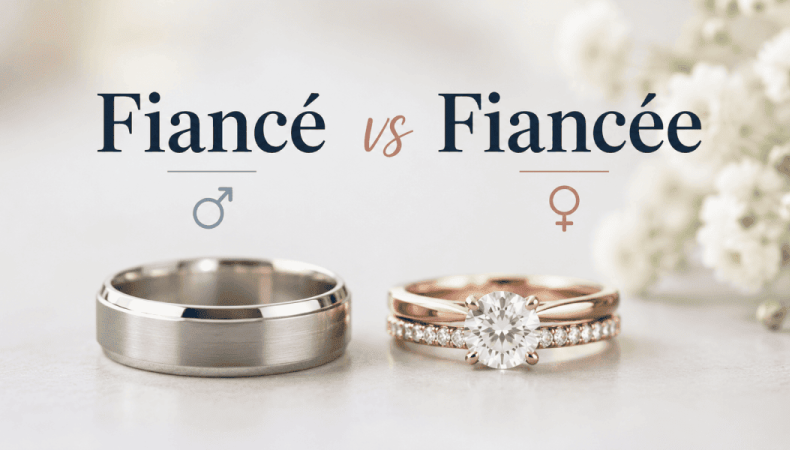
The most common grammar and relationship-related mistake that people often make is when they use these two words: fiancé and fiancée. These words often create confusion. The reason these words create confusion is that they look almost the same, sound nearly identical and both are connected to engagement and marriage. Because of this, people get confused and often use them interchangeably.
They may have a small difference but there it is significant. Knowing the difference can help you avoid confusion and use them the right way. So, here we are with the differences between Fiancé vs Fiancée so that you can use the word at the right place. So, without ado, let’s get started…
Fiancé vs. Fiancée: Understanding the Meaning
Of course, there is a simple yet important difference between fiancé and fiancée. The good news is that once you understand how each word is used, telling them apart becomes much easier. So, here is the difference:
Fiancé
The word fiancé is used for a man who is engaged to be married. This means that this word is used by women while talking about the man she is going to marry. She would call him her fiancé after the engagement.
Example:
- My fiancé and I are planning to host a destination wedding this winter.
- She introduced her fiancé at her cousin’s wedding.
- Lisa plans to introduce her fiancé Robert to her friends at the party.
The word fiancé describes a future husband here. The one who is yet to become a husband because the marriage has not happened yet.
Fiancée
The word fiancée, on the other hand, is used by a man for a woman who he is engaged to be married to. A man calls the woman he is going to marry his fiancée whenever he talks about her.
Example:
- My fiancée wants a simple and minimal wedding.
- Daniel proposed to his fiancée during their vacation.
- Tom plans to introduce his fiancée to all his friends at the party tonight.
The word fiancée describes a future wife here. The one who is yet to become a wife because the marriage has not happened yet.
Fiancé and Fiancée: The Origin
Both words fiancé and fiancée come from the French language. Different spellings for masculine and feminine words are often used in the French language.
Fiancé is the masculine form, while fiancée is the feminine form. Most importantly, the accent mark over the “e” is also from French.
In English, many people skip the accent and simply write fiance or fiancee. Both are considered the same but the more correct spelling is the one with the accent marks. Hence, fiancé and fiancée are the proper forms.
Fiancé vs Fiancée: The Main Differences
Well, the main difference between these two words is of only gender.
- Fiancé is used for engaged man
- Fiancée is used for engaged woman
That extra “e” at the end of word fiancée changes the word from masculine to feminine.
It may have a tiny spelling difference; however, the meaning and its uses change significantly.
That’s the reason people must use the correct word, especially in formal writing like wedding invitations, announcements, social media captions and relationship blogs.
Fiancé and Fiancée: How to Pronounce These Two Words
You will be surprised to know that both the words are pronounced almost the same. They are usually said like ‘fee-ahn-say’
As said earlier, the pronunciation of these two words is nearly identical. It usually depends on the spelling to understand which word is being used in a particular context.
Fiancé vs Fiancée: Where from Confusion Comes
People often get confused between these two words because both of these words look and sound similar. Most importantly, both words are related to engagement and marriage. However, they are pronounced almost the same, which makes it difficult for many people to make the difference. The only visible difference is the extra “e” at the end of fiancée, which often people miss while writing or reading quickly.
In simple words, these two are French language gender-based spelling, which are often used interchangeably. People often assume that both words mean exactly the same thing. This is why fiancé and fiancée are commonly mixed up in conversations, social media posts and even formal writing. But one should keep the difference in mind when using these words. Read ahead for the quick tips to remember the differences. Here we go…
Important Tips to Remember the Difference
- Always remember that the feminine version of this word has an extra “e” at the end, which makes it fiancée.
- You can connect that extra “e” with the word female. Extra “e” is for a woman who is going to be a future wife.
- Remember that a fiancé has only one “e” with the accent mark over it and it is for a man who is going to be a future husband.
Keeping these simple tips in mind can help you avoid the mistake that most people make when using these two genders-based words.
Read Also: Build A Bond With Your Fiance During The Courtship Period
Common Mistakes People Make When Using Fiancé and Fiancée
Here are some common mistakes that people often end up making while using these two words:
Example 1:
Wrong: My fiancée is the most talented guy in the group.
This is wrong because a woman is talking about her future husband. The correct sentence would be My fiancé is the most talented guy in the group.
Example 2:
Wrong: I am going to meet my fiancé at her place.
Here the man is talking about his future wife and the use of the word fiancé is wrong. The right sentence would be: I am going to meet my fiancée at her place.
Making a mistake is not a huge problem, even native English speakers also make such mistakes. But knowing and understanding the difference can help you avoid embarrassment.
Can The Same Word Be Used for Both Men and Women?
Well, technically NO! Some people however use fiancé for both men and women because it feels simpler and also avoids confusion. While others often prefer avoiding both the words and use simpler words, such as future wife, partner or future husband instead. These words may work in informal speeches. However, in formal writing, you are advised to use the correct words: fiancé for a man and fiancée for a woman.
Read Also: What Is ‘Pre-Engaged’ A Modern Relationship Stage Explained
Fiancé vs Fiancée: How To Use These Words in Everyday Life
Here are the use cases of fiancé and fiancée to make everyday conversation feel like a breeze. Take a look…
- Domestic Event: “We are excited to introduce the newly engaged couple, Reeta and her fiancé, Jack.”
- Wedding Invitation: “We are delighted to introduce Albert and his fiancée, Avril.”
- Social Media Caption: “Enjoying hiking with my beautiful fiancée.”
- Family Introduction: “This is my fiancée, Lisa. We are getting married next spring.”
- Office Conversation: “My fiancée and I are busy finalizing our wedding venue.”
How Long Do the Terms Fiancé and Fiancée Apply?
The terms fiancé and fiancée apply from the moment you get officially engaged to your partner until you get married. Yes, after the wedding, these words are no longer used. These words are used to show that the couple is committed to marry but have not yet had the wedding ceremony. Once the marriage takes place, these terms no longer apply. After that, the fiancé becomes the husband and fiancée becomes the wife. In simple words, these titles are only used during the engagement phase before marriage. For example:
Before marriage: “He is my fiancé.”
After marriage: “He is my husband.”
Similarly, a woman who once happened to be a fiancée before wedding becomes a wife.
The Bottom Line
So, these are the differences between fiancé and fiancée. Hopefully, this article has been informative for you and helped you understand the unique yet subtle difference between fiancé vs fiancée. They may have only a spelling difference, but the meaning changes significantly with that one spelling difference.
Hence, you are advised to use these terms correctly to avoid embarrassment, especially when writing. Writing them correctly shows attention to detail and helps avoid confusion. Whether you are writing a wedding announcement, introducing your future spouse, or simply improving your vocabulary, knowing this difference can be very useful to make a big difference. Happy Wedding… 😊 😊
![110 Heartfelt Engagement Anniversary Quotes [2024]](https://www.happywedding.app/blog/wp-content/uploads/2024/02/110-Heartfelt-Engagement-Anniversary-Quotes-2024-300x171.jpg "110 Heartfelt Engagement Anniversary Quotes [2024] - Happy Wedding App")